The high wire act of Andrey Rublev and Marat Safin
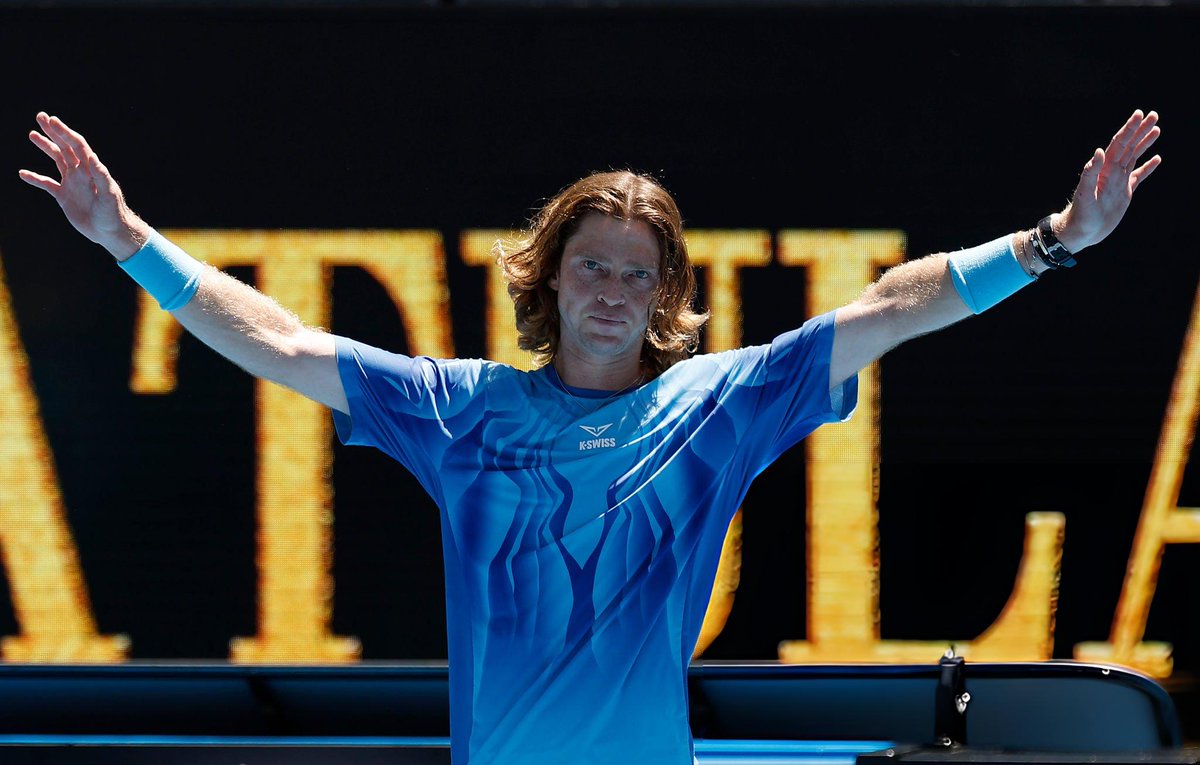
In the quiet, clinical atmosphere of the Australian Open press room, Andrey Rublev often looks like a man who has just survived a storm.
His hair is famously unruly, his eyes carry the weight of a thousand baseline battles, and his voice typically flickers with a nervous, honest energy. But following his four-set victory over Jaime Faria at the 2026 Australian Open, there was a different undercurrent to the World No. 15.
For the first time in a long time, the volcanic Russian seemed to have found a pilot for his fire.
That pilot is none other than Marat Safin. The partnership, which began in the spring of 2025, has become the most fascinating experiment on the ATP Tour.
It is the union of two of tennis’s most expressive, combustible, and brilliant Russian exports. On paper, it looks like a powder keg. In reality, Rublev insists it is the only thing keeping him level.
“I mean obviously I’m not going to say the truth,” Rublev teased with a wry smile when asked about the legendary 2005 Australian Open champion’s influence on his camp. Then, the sincerity broke through: “But he brings everything and yeah much more calmness for sure as well that’s it’s enough.”
“Calmness” is a word rarely associated with Marat Safin’s playing days — a career defined by smashed rackets, flower-power player boxes, and a level of raw talent that could flatten anyone on his day.
Yet, as Rublev navigates the mid-career transition from “top-ten staple” to “Grand Slam contender,” Safin has emerged as the elder statesman who finally speaks his language.
The transformation isn’t just mental. Rublev spent his off-season being pushed to the brink of his physical limits. He recently admitted that Safin and his team were “killing him” with a regimen that felt more like a boot camp than a tennis camp.
For Rublev, who has historically struggled with a self-admitted tendency to unravel when things go south, the discipline of Safin — a man who has seen every high and every low the sport offers — has provided a necessary anchor.
Against Faria, we saw the “Safin Effect” in real-time. After breezing through the first two sets, Rublev hit a snag. The third set slipped away. In the fourth, he found himself serving for the match and, in a classic “Rublev moment,” coughed up three double faults to lose the break.
In years past, this would have been the precursor to a total emotional collapse—the shouting, the self-flagellation, the inevitable exit. Instead, Rublev stayed. He reset. He broke back immediately and closed the match 7-5.
“The fourth set was I think good level set from both side,” Rublev reflected. “In the end I played when I was for the match I make three double folds uh but can happen this outside of that I think the the fourth set was good level.”
The nonchalance of that “can happen” is perhaps the greatest victory of the Safin era. There is a sense of perspective now. Safin, who once famously pulled his pants down at the French Open to celebrate a winner, has taught Rublev that the sport is meant to be lived, not just suffered through.
When a journalist asked if Safin brings a sense of fun to the team — referencing the viral Instagram photos of the duo — Rublev didn’t hesitate.
“I mean we make fun we make fun,” he said. “We make fun together but then depends uh depends on the day when it’s a more serious day then we try to make it Yeah more serious but yeah when it’s time for fun we make fun as well.”
The “serious days” are where the work happens.
Rublev knows that with Safin, there is no room for half-measures. He has previously noted that if he stops listening or working, Safin “won’t waste his time.” That mutual respect, born from Rublev growing up watching Safin as his idol, has created a high-wire act that actually feels stable.
As Rublev moves into the third round to face Francisco Cerundolo, the tennis world is watching closely. We know Rublev has the power. We know he has the heart. What we are waiting to see is if the “much more calmness” Safin provides can finally carry him past that elusive Grand Slam quarterfinal hurdle.