The Bengaluru miracle and how a college kid rewrote Indian tennis history
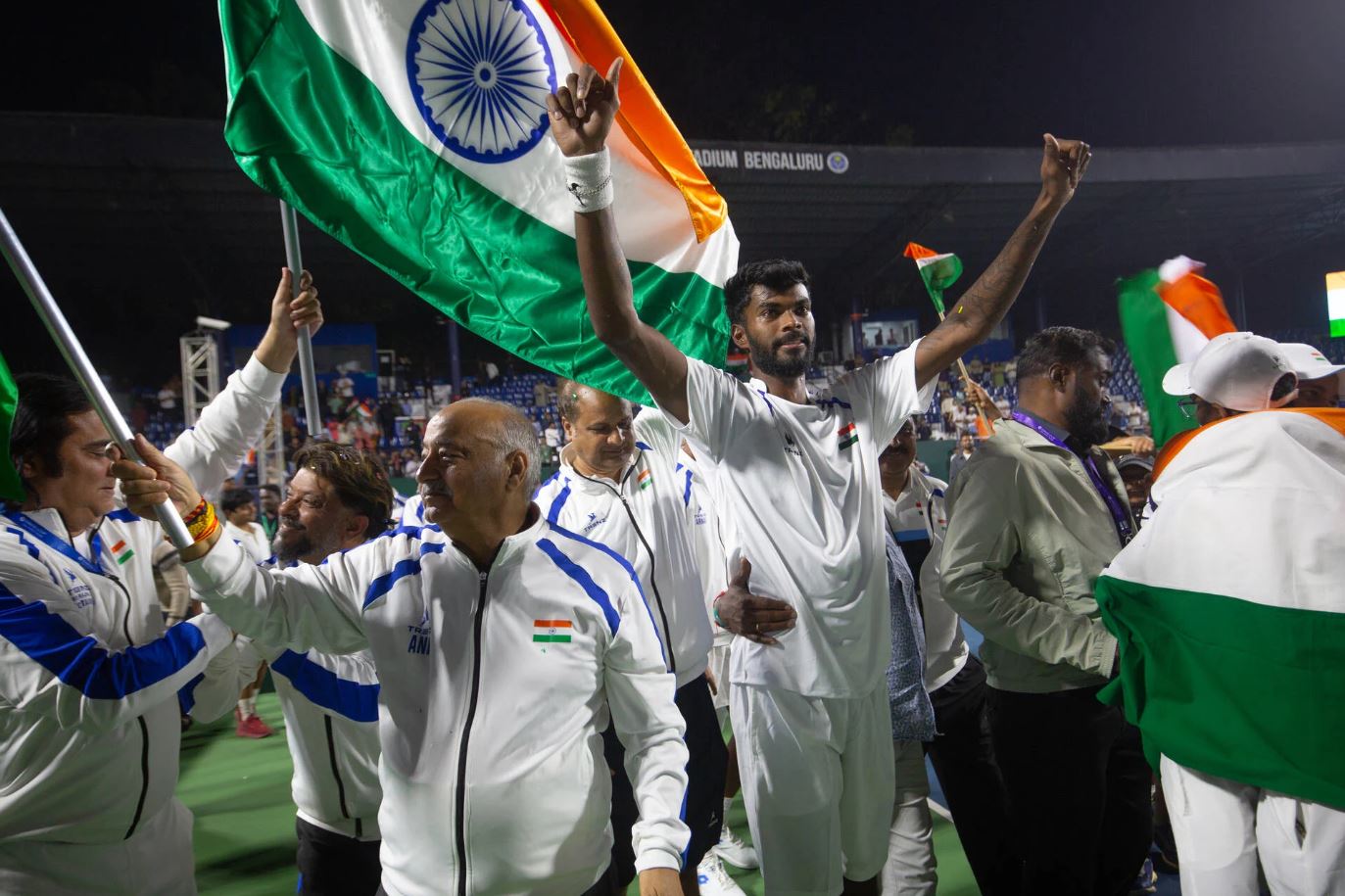
I’ve covered tennis for a long time, but I’ve rarely seen the air in a stadium vibrate the way it did this Sunday in Bengaluru.
Under the harsh glow of the floodlights, we didn’t just witness a Davis Cup victory; we witnessed an arrival. Dhakshineswar Suresh, a 25-year-old student at Wake Forest University ranked 457th in the world, carried the weight of a nation on his shoulders and delivered a performance that felt like a fever dream.
By the time Suresh buried an inside-out forehand to clinch the deciding fifth rubber against Guy Den Ouden, the statistics felt secondary to the sheer emotion of the moment.
Yet, those stats tell a story of an individual tour de force we haven’t seen since the golden era of Indian tennis. By winning his two singles matches and a grueling doubles encounter, Suresh became the first Indian player since the legendary Leander Paes in 2004 to claim three points in a single tie.
The weekend began as an uphill battle against a Dutch side that reached the Davis Cup finals just two years ago. On Saturday, Suresh set the tone by dismantling World No. 88 Jesper de Jong in straight sets — a result many dismissed as a fluke. By Sunday morning, it was clear it was anything but.
The day started with Suresh pairing up with Yuki Bhambri for the first time. Facing the specialist duo of David Pel and Sander Arends, the Indians looked like seasoned veterans.
It was a three-hour marathon defined by razor-thin margins, ending in a 7-6(0), 3-6, 7-6(1) triumph that gave India their first lead of the tie. Suresh’s energy was infectious, bridging the gap between Bhambri’s tactical precision and the raw power required to topple the Dutch specialists.
However, the drama was only beginning. India’s top-ranked star, Sumit Nagal, stepped onto the court for the first reverse singles against a vengeful De Jong. What we didn’t know then was that Nagal was battling a grade two tear in his right thigh.
He lost the match 5-7, 6-1, 6-4, but in doing so, he may have saved the tie. Nagal’s three-hour defensive masterclass, played in obvious physical distress, bought Suresh vital recovery time after his doubles exploits. It was the ultimate “teammate” performance.
The stage was set for a winner-take-all fifth rubber. The World No. 457 versus World No. 162, Guy Den Ouden. On paper, the Dutchman was the fresher, higher-ranked player. On the court, he was a man searching for answers that Suresh refused to provide.
Suresh served with a clinical, almost robotic efficiency. He hammered 15 aces and remarkably didn’t face a single break point the entire match. He broke Den Ouden in the seventh game of the first set and never looked back, closing it out 6-4 as the Bengaluru crowd transformed the Stadium into a cauldron of noise.
The second set was a war of nerves. Den Ouden dug deep, saving two break points in the fifth game and clawing his way to a 3-1 lead in the tie-break. For a moment, it felt like the momentum was shifting.
But Suresh, fueled by a partisan crowd and perhaps the sheer audacity of his own run, reeled off four straight points. When that final forehand winner zipped past Den Ouden to secure the 6-4, 7-6(4) win, Suresh collapsed onto the court with a mix of exhaustion and ecstasy.
This 3-2 victory is a milestone because India has now won three consecutive Davis Cup ties for the first time in over a decade.
We are deeper into the tournament than at any point since the 15-year-old heartbreak against Serbia in the last 16. The “World Cup of Tennis” has finally seen the sleeping giant of Asian tennis wake up.
In September, the squad travels north to face South Korea on their home turf. With Hyeon Chung showing glimpses of his former self in their win over Argentina, it will be a monumental task.
But after watching a college student from Wake Forest dismantle a top-tier European power, I suspect no one in that locker room feels like an underdog anymore.