Lucky loser Elisabetta Cocciaretto stuns a flat Coco Gauff in the desert
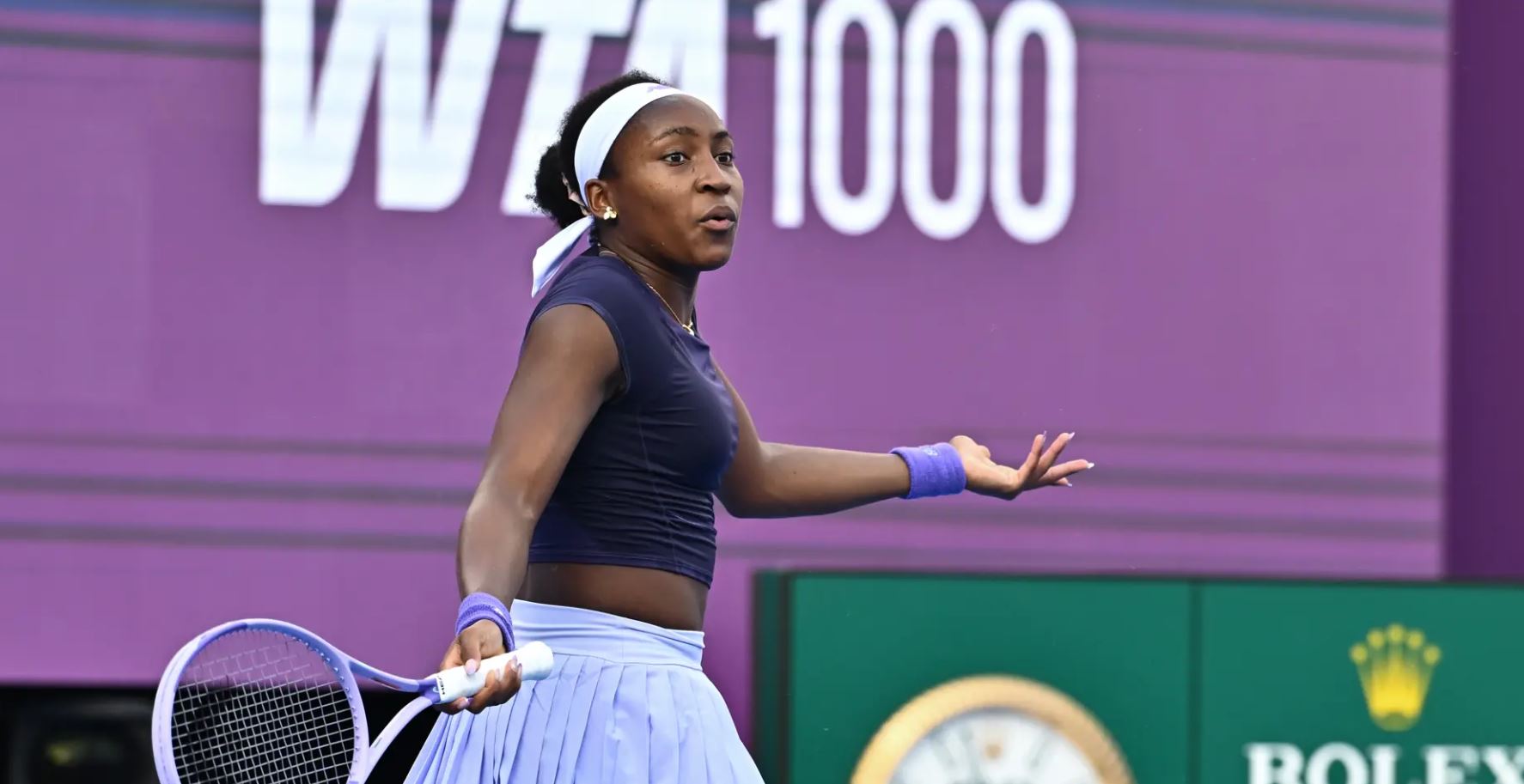
It is a disorienting experience to listen to a world-class athlete describe a reality that doesn’t quite match the one you just witnessed on center court.
I’ve spent some time watching Coco Gauff on the practice courts. In the desert sun, she’s been a vision of technical refinement. Her serve snapping with newfound reliability, her movement fluid.
But on Tuesday night at the Qatar TotalEnergies Open, that version of Gauff stayed in the locker room. In her place was a player caught in a tactical purgatory, suffering a 6-4, 6-2 defeat at the hands of Elisabetta Cocciaretto that felt both sudden and entirely predictable.
For Gauff, the No. 4 seed, this was a recurring nightmare in a city that has never been kind to her. Coming off a first-round bye, she looked physically present but competitively “out of sorts,” marking her second straight defeat since her deep run at the Australian Open.
After the match, Gauff was remarkably candid. There was no hiding behind excuses, though the frustration was etched into her face.
“I just feel like I haven’t showed up with my best level the last few matches,” she said, her voice carrying a weight that suggested she’s been overthinking the mechanics of her game. “I’m just looking to find that again.”
The most jarring aspect of the night was the disconnect between her preparation and her performance. Gauff is currently grappling with what I’d call the “Practice Court Paradox” — the inability to bridge the gap between low-pressure drills and high-stakes execution.
“I just feel like some of the things I’ve been working on in practice aren’t translating to the match court, which is super frustrating,” Gauff admitted. “I’ve been having good practices, but just not playing well in the matches. I just need to find how it can translate.”
The match itself was a masterclass in how to exploit Gauff’s current technical vulnerabilities. Cocciaretto, a lucky loser who previously hadn’t won a set against Gauff in three tries, played with a “nothing to lose” aggression that forced Gauff into a defensive shell.
On the slow hard courts of Doha, Gauff’s usual safety net — that heavy, spinning forehand — failed her. Without the pace to push the Italian back, Gauff was forced to choose between two losing strategies.
“I tried to be more aggressive and was hitting more unforced errors,” Gauff explained to me. “When I tried to be a little more passive and play with more shape, she was taking the ball early and crushing the ball.”
It was a brutal feedback loop. By the end of the night, Gauff had racked up a staggering 39 unforced errors against just 13 winners. The forehand, in particular, seemed to unravel under the pressure of Cocciaretto’s flat hitting.
“I think I need to figure out how to play against players like her, who hit super flat and take everything early,” Gauff noted. “I think the last two matches showed I’ve been struggling with that. That’s something I need to work on in practice.”
If there is a silver lining, and Gauff is the type of player who will search for one until she finds it, it is her serve. Once a liability that could derail her entire mental state, her delivery remained relatively stable even as the rest of her game crumbled.
“Today, with only three double faults, that’s positive, and same with the matches I had in Australia,” she said. “I think there weren’t many double faults there, as well. That’s the one positive. Now I need to figure out what I’m doing off the ground to lose these matches.”
However, the “ground” she’s referring to might be more psychological than physical. Gauff is a two-time Grand Slam champion at 21; she has the credit in the bank, but she’s currently facing a hurdle that no amount of athleticism can clear. It’s a mental block that appears only when the lights are brightest.
“Physically, I know I can do it and I can do it when there’s not much pressure,” she confessed. “I need to figure out how to do it when there’s more pressure.”
As the Doha draw continues without its top-five American star, Gauff is already looking toward the Dubai Duty Free Tennis Championships. She has historically found success there, reaching the semifinals in 2023, but the questions surrounding her forehand and her match-day temperament will surely follow her.
Remodeling a forehand is not like fixing a serve; it’s an “open skill” that requires reacting to a thousand different variables in real-time. Whether Gauff can find the balance between aggression and shape before the tour turns to the American hard courts will likely define her 2026 season.