Iga Swiatek finds freedom in the normal pursuit of excellence
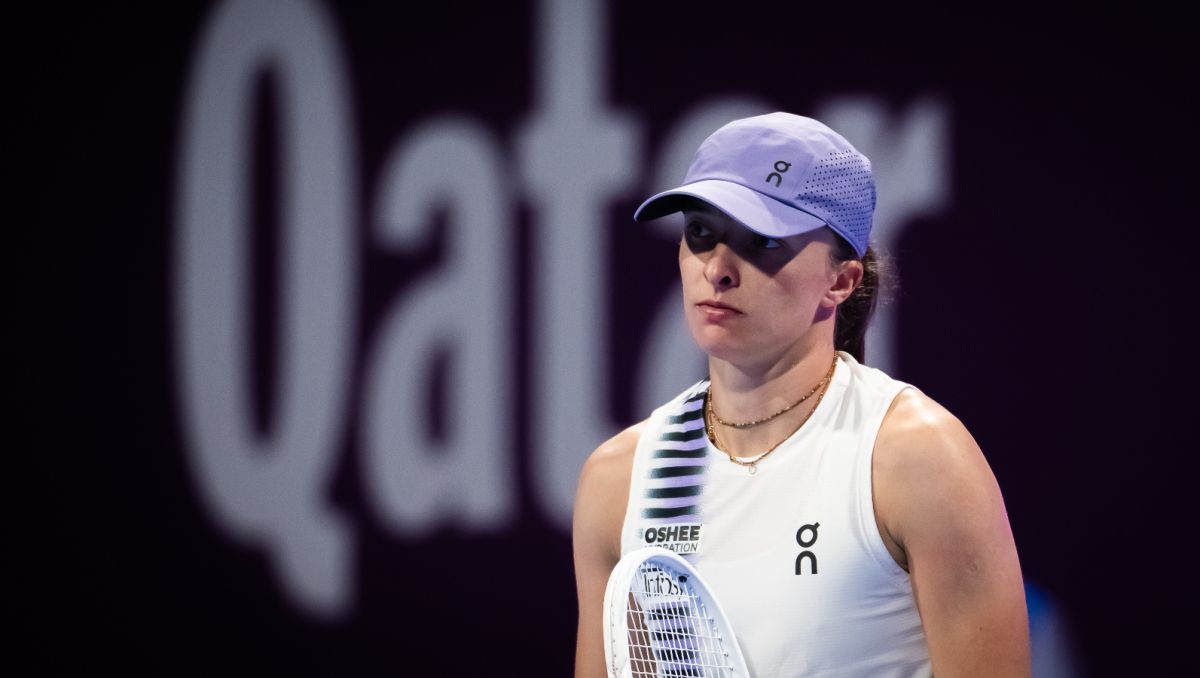
The desert air in Doha can be deceptive. As the sun sets over the Khalifa International Tennis & Squash Complex, the temperature drops, the wind picks up, and the game changes.
For Iga Swiatek, the world’s most clinical frontrunner, the conditions during her opening match against Daria Kasatkina were more than just a meteorological nuisance; they were a mirror.
A year ago, Swiatek walked into this same press room carrying the heavy, invisible armor of a defending champion who felt the math of the rankings was a riddle she couldn’t quite solve.
Back then, there was a palpable sense of frustration—a feeling that the points she had earned were a burden to protect rather than a reward for her labor.
But as she sat before the microphones following a 5-7, 6-1, 6-1 victory, the armor seemed to have vanished. In its place was a player who has traded the anxiety of “defending” for the clarity of “working.”
The shift is subtle to the casual observer, but for those who follow the fluctuating psychological tides of the WTA tour, it is profound. Swiatek is no longer looking at the rankings as an external force acting upon her. She is looking at them as a scorecard.
“Well, last year, you know, I came back after my case after, like, not having opportunity to play the tournaments sometimes,” Swiatek reflected, acknowledging a period where her career felt dictated by circumstances beyond the baseline. “So it was a totally different stage of my career even, I would say. I’m not thinking about that any more.”
That refusal to look back is perhaps her greatest tactical improvement of the season.
In professional tennis, the “ranking points” system can often feel like a treadmill that never stops—you run just to stay in the same place. For a young player who ascended to the throne with such velocity, the realization that every win is merely a temporary lease on the No. 1 spot can be paralyzing.
But Swiatek has found a way to “normalize” the extraordinary. By stripping away the noise of the points race, she has reconnected with the raw mechanics of the sport.
“I’m just focused on work and, yeah, that’s it,” she said with a light laugh that punctuated the end of a long, tactical day. “I mean, whatever happens now with points it’s because of my level, not because I couldn’t play. It’s a much more normal situation in sports, I would say.”
This “normal situation” is what makes Swiatek so dangerous right now. When a champion stops worrying about the consequence of the loss and starts focusing on the quality of the “level,” they become harder to break.
We saw it in the second and third sets against Kasatkina. After a first set where she admitted she “wasn’t playing practically,” Swiatek didn’t panic about the potential exit or the points dropping from her tally. She simply went back to the lab.
The result was a demolition. She didn’t just win the next two sets; she solved the problem.
Looking ahead to her next clash with Maria Sakkari—a rivalry that has historically tested her resolve—Swiatek is carrying this new philosophy into the fray. She respects the physicality of the matchup, but she isn’t overcomplicating the narrative. The frustration of 2024 has been replaced by the “smarter” tennis of 2026.
“In tennis there are both people playing, so I would need to, I don’t know, maybe watch and see,” she noted regarding her tactical adjustments. “But for sure I felt like I could do sometimes more in the first set. Yeah, didn’t really adjust well to the colder conditions and the wind. For sure it’s a lesson for next days.”