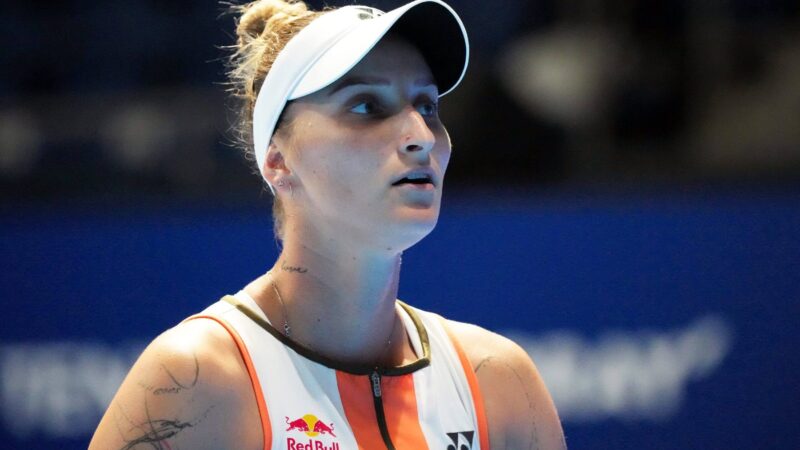
Marta Kostyuk breaks the curse of the teenage prodigy

For many years, the tennis world viewed Marta Kostyuk through a singular, frozen lens. The 15-year-old girl with the bubbly personality who charged into the third round of the 2018 Australian Open.
It was a breakthrough that felt like a beginning, but for the girl at the center of the storm, it became a weight that nearly broke her career before it truly began.
Sitting in the press room of the Caja Magica Saturday, trophy in hand after securing her first WTA 1000 title in Madrid, the 23-year-old Kostyuk finally looked like a woman who had stepped out from under a long, dark shadow.
The victory over Mirra Andreeva was significant for the rankings, but the emotional release in the press conference revealed a deeper triumph.
“I think in the beginning of this year I told my team that I finally feel that the achievements that I had when I was 15 years old are not um how do you call it it doesn’t no it yeah it doesn’t have a weight on me anymore,” Kostyuk admitted, her voice steady and reflective.
The “weight” she describes is the peculiar burden of the teenage prodigy. In 2018, as a World No. 521, she became the youngest player since Martina Hingis to reach the third round in Melbourne.
Overnight, she was branded the “future of tennis.” But while the world was busy calculating her trajectory toward World No. 1, Kostyuk was beginning a silent struggle with the reality of living up to a ghost version of herself.
“I was living for many years in that state of you know everyone expecting big results from me,” she said. “Having such a good results being so young was almost like a curse.”
That curse manifested as a plateau that saw her fight to remain in the Top 50 for years, often labeled as a player who had stalled.
It is a narrative all too common in the women’s game, where early success is frequently mistaken for a finished product. For Kostyuk, the breakthrough felt like a ceiling.
The journey to shed that skin involved more than just technical adjustments.
It required a fundamental re-evaluation of her identity, particularly her professional relationship with her mother, Talina Beiko. The parent-coach dynamic is often the most combustible element in a young player’s development, and Kostyuk was candid about the difficulty of evolving that bond.
“I was growing up being coached by my mom. It’s never easy to go out of this relationship and to be able to do that,” Kostyuk shared. “I’m happy I got out on the other side a better uh better person better player. U you know it it definitely took a lot of struggling and a lot of difficult moments.”
She was quick to clarify that the separation was professional, not personal, noting that she still calls her mother for support and even held a training camp with her before the clay season.
But the independence she found — the ability to be “Marta” the adult rather than “Marta” the prodigy—is what allowed her to finally find joy in the sport again.
“I think when I freed myself from you know that that actually it’s incredible and I’m very proud of myself that I managed to achieve all of that when I was 14 and 15 years old um that definitely gave me just the freedom to enjoy you know this sport and just play it,” she said.
In Madrid, that freedom was on full display.
She played with a tactical maturity that matched her renowned athleticism, navigating two tight sets against another teenage standout, Andreeva. Where a younger Kostyuk might have crumbled under the pressure of set points down, this version remained grounded.
Now sitting at a career-high ranking of World No. 15, Kostyuk is no longer chasing the ghost of the 15-year-old from Melbourne. She has replaced the “curse” of expectation with the reality of achievement.
“For me you know almost nothing changes,” she concluded with a smile that suggested everything actually had. “I want to just keep doing the same thing and keep working and keep enjoying this journey because you know it’s about journey. It’s not about destination.”